
When examining Moroccan door history, one quickly realizes that these structures are far more than mere entrances. They represent a sophisticated synthesis of mathematical precision and cultural identity that has evolved over centuries. Understanding the deep roots of these designs requires looking beyond the aesthetics to the geometry that governs every carve and joint.
Moroccan door history is inextricably linked to the development of the Islamic Golden Age, where artisans treated the threshold as a sacred transition between the public and private realms. By studying the progression of these designs, we gain insight into how ancient master builders balanced structural integrity with symbolic complexity. This article explores the evolution of the geometry that remains the heartbeat of authentic Moroccan craftsmanship today.
The Mathematical Foundations of Traditional Design
The core of every authentic entrance lies in the principles of Euclidean geometry. Artisans traditionally utilize a compass and straightedge to establish perfect proportions before a single strike of the chisel occurs. This mathematical rigor ensures that every element of the door, from the frame to the central panel, adheres to a harmonious ratio that feels inherently balanced to the human eye.
The Role of the Golden Ratio
Historically, the placement of the arch and the dimensions of the rectangular panels were guided by the golden ratio. This intentional spacing creates a visual flow that mimics natural organic growth, which is a hallmark of traditional Moroccan architecture. By maintaining these specific ratios, artisans ensure that even the most massive cedarwood doors possess an elegance that prevents them from overwhelming a room.
Material Science and Geometric Longevity
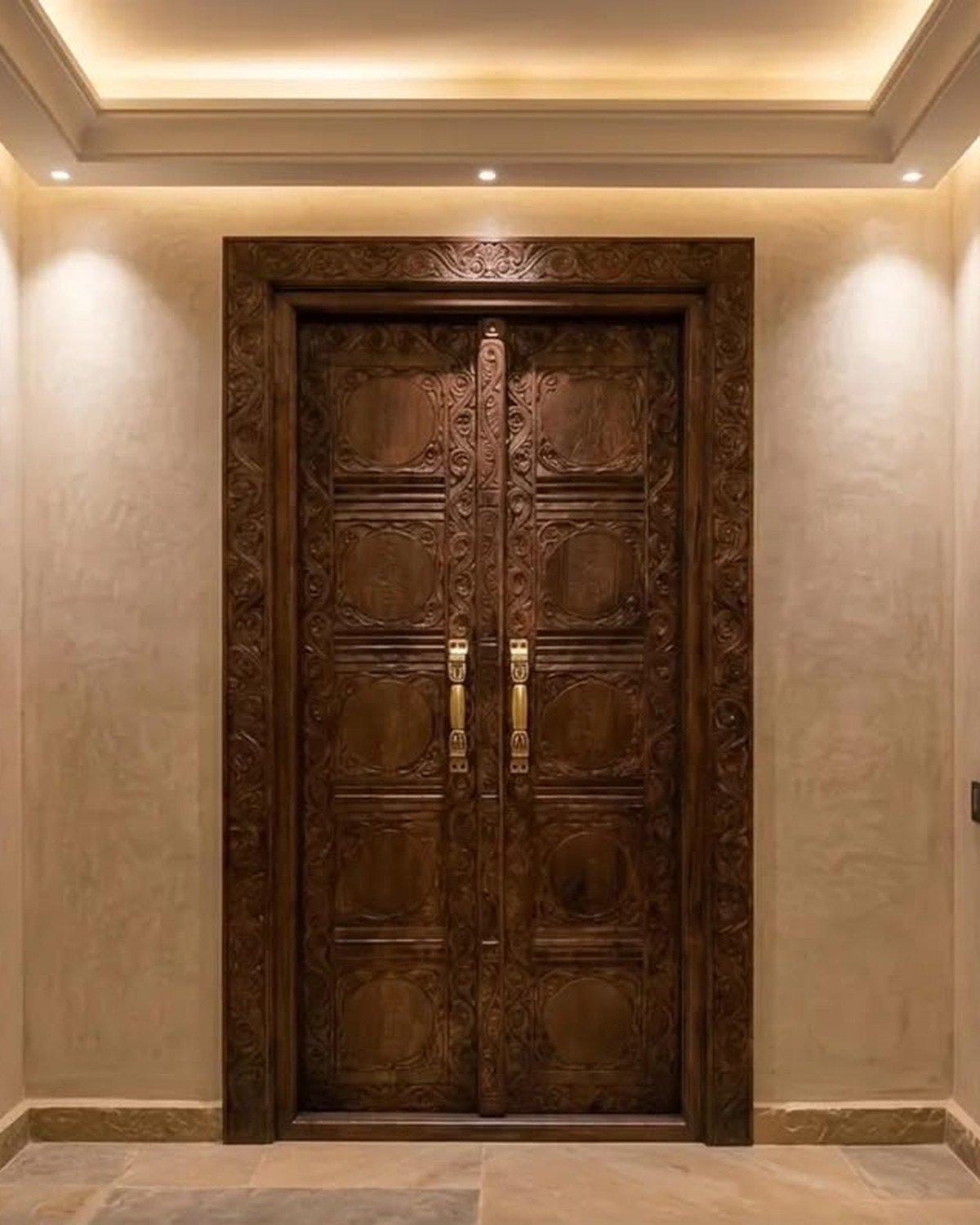
In Moroccan door history, the choice of material is never arbitrary. Cedarwood from the Atlas Mountains has remained the preferred medium for centuries due to its density and natural resistance to the arid climate. Its unique properties allow for intricate carvings that hold their crisp edges for generations, which is why ateliers like ALQASR continue to source this timber for contemporary projects.
Integrating Metal and Wood
The marriage of brass hardware with cedar is another technical evolution that defines Moroccan door history. Early artisans discovered that brass studs and plates were not merely decorative but served to reinforce the structural joints of the heavy timber. This practice of functional ornamentation allowed builders to create doors that functioned perfectly under the stress of daily use while maintaining a jewel-like appearance.
The Evolution of Architectural Motifs in Moroccan Door History
While basic shapes have remained constant, the decorative motifs inscribed upon them have shifted through various dynasties. The Merinid era, for instance, introduced a level of complexity in star-pattern carving that remains the gold standard for master carvers. These motifs were often inspired by the celestial observations of ancient scholars, turning every entryway into a literal map of the cosmos.
From Public Gates to Private Homes
Over time, the grandeur of city gate designs filtered down into the domestic architecture of the riad. Wealthy merchants sought to replicate the monumental scale of public architecture within their own homes, leading to the adaptation of smaller, more delicate versions of these historic designs. This democratization of high art allowed the geometric traditions of the kingdom to permeate every aspect of Moroccan residential life. This shift from palace to home is one of the defining turning points in Moroccan door history.
Preserving the Legacy in Modern Spaces
Today, the challenge for modern makers is to uphold these historic standards without sacrificing quality. As practitioners of these traditional methods, ALQASR emphasizes the importance of hand-finishing every piece to ensure the longevity of the intricate patterns. When selecting a door for a contemporary space, one should look for these hallmarks of traditional geometry, such as deep-relief carving and perfectly aligned joinery, to ensure the piece honors its heritage. In the end, Moroccan door history is not a closed chapter: every authentic piece carved today continues it.
Frequently Asked Questions
Why is cedarwood the primary material for historic doors?
Cedarwood is favored for its remarkable durability, resistance to pests, and ability to hold fine detail during the carving process. Its pleasant aroma and natural oils also contribute to the longevity of the finish, allowing the wood to age beautifully over centuries.
How does geometry affect the perceived size of a room?
Geometric patterns and balanced door proportions draw the eye, creating a sense of order and intentionality. By using the golden ratio in door design, artisans ensure that the piece acts as a focal point that provides visual depth, making a room feel more expansive and harmonious.
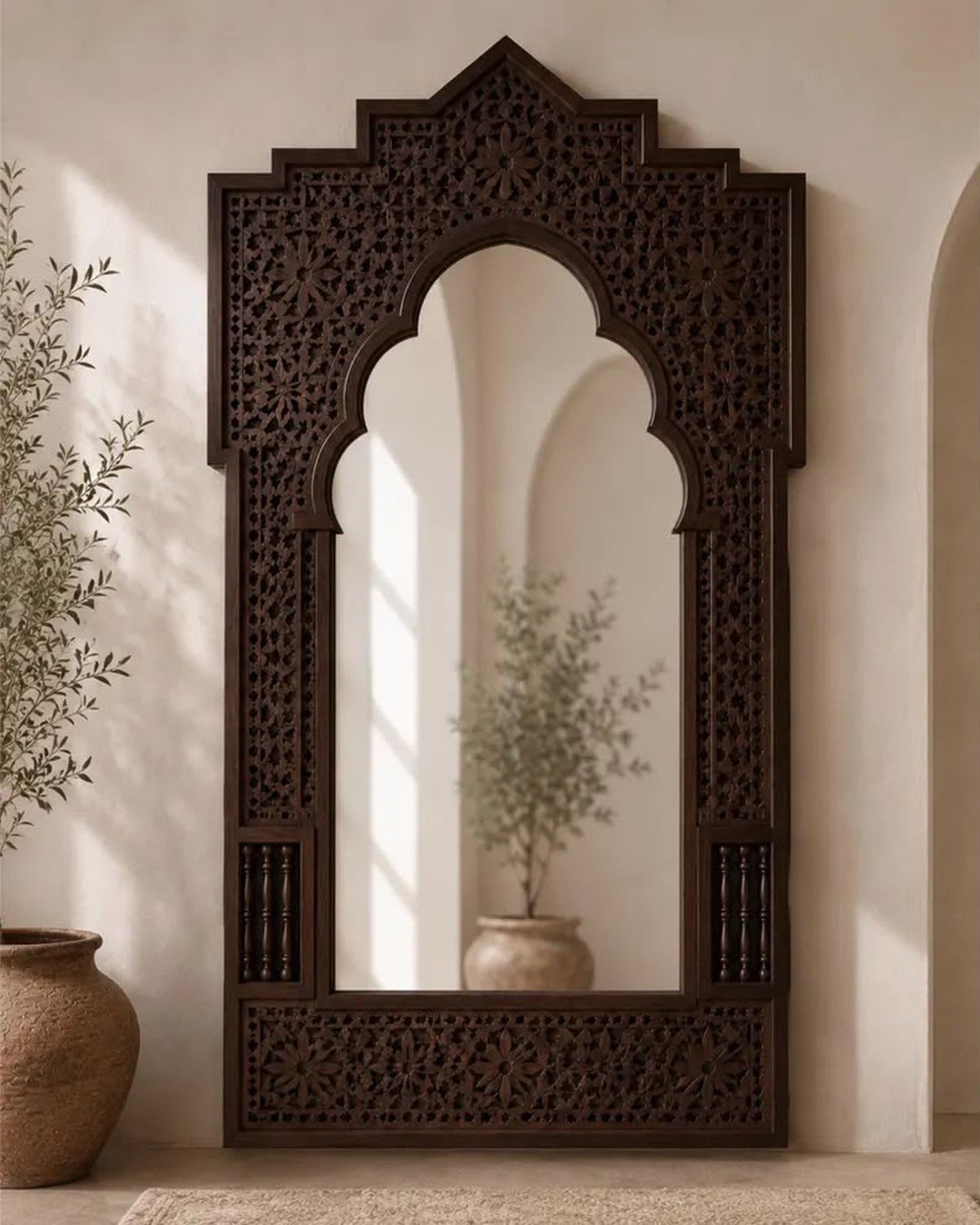
Explore Our Handmade Moroccan Doors & Mirrors

Further reading: Tadelakt plaster on Wikipedia.